 Want to enjoy the feeling of affluence in Japan? Omotesando is an area in Tokyo where you can find nice cafes and delicious restaurants. There are many brand name boutiques as well; and the area is famous for having many rich people around.
Showing posts with label location. Show all posts
Showing posts with label location. Show all posts
Tuesday, December 22, 2009
Omotesando
Want to enjoy the feeling of affluence in Japan? Omotesando is an area in Tokyo where you can find nice cafes and delicious restaurants. There are many brand name boutiques as well; and the area is famous for having many rich people around.

Monday, December 7, 2009
Tokyo Tenbodai
Take a look at Tokyo from the above!
Haneda Airport Big Bird Observation Deck

It is located on both terminals of the Haneda Airport. For terminal 1, it is located on the 6th floor and as for terminal 2; it is located on the 5th floor. You can observe both from inside and outside, and from the outside you can see the airplane flying above their head from the open terrace located outside. They also have a play area for kids at terminal 1 and at terminal 2 you can view the whole panoramic view of the Tokyo bay area. It opens at 6AM and it closes at 10PM and the fee is free.
Haneda Airport Big Bird Observation Deck

It is located on both terminals of the Haneda Airport. For terminal 1, it is located on the 6th floor and as for terminal 2; it is located on the 5th floor. You can observe both from inside and outside, and from the outside you can see the airplane flying above their head from the open terrace located outside. They also have a play area for kids at terminal 1 and at terminal 2 you can view the whole panoramic view of the Tokyo bay area. It opens at 6AM and it closes at 10PM and the fee is free.
Wednesday, November 18, 2009
Long Nights? Art is the answer...

Saturday, November 14, 2009
When Tokyo Lights Up…
Tis’ the season to be jolly, and tis’ the season Tokyo starts to become filled with glimmering lights of illumination. Tokyo bustles with holiday illuminations during Christmas season. Many of these illuminations start to light around this time of the year, until as late as Valentine’s Day.
Here are some of the beautiful seasonal lightings around Tokyo:

Shiodome:
Instead of the red and green lights, Caretta Shiodome centers on the theme of “ocean” for the holiday lighting. Splendid fields of blue illuminations will surround you and amaze you this winter.
Displayed from: Dec. 1 – 25, 2009
Here are some of the beautiful seasonal lightings around Tokyo:

Shiodome:
Instead of the red and green lights, Caretta Shiodome centers on the theme of “ocean” for the holiday lighting. Splendid fields of blue illuminations will surround you and amaze you this winter.
Displayed from: Dec. 1 – 25, 2009
Thursday, October 1, 2009
Fukuoka - Greatest in Kyushu -

All the way down in the Kyushu area, there is Fukuoka Prefecture, the most populous and the most active prefecture in Kyushu. In Fukuoka, there is Fukuoka City which is also famous for being one of the five biggest cities in Japan, along with Tokyo, Osaka, Nagoya and Sapporo. Today, I will introduce to you two interesting places you can visit in Fukuoka.
Monday, September 28, 2009
Local Area Specialties -Starbucks Tumbler-

Looking for a Japanese souvenir for a coffee-addict? If so, there is a perfect gift at Starbucks Coffee in Japan. In almost every prefecture you can purchase a Starbucks tumbler (or a mug) with design that made exclusively in that specific prefecture. In other words, it is a specialty tumbler! All of them are designed in a way that depicts that specific prefecture and is very cute and fashionable! I will briefly explain what the tumblers of some prefectures look like!
Thursday, September 17, 2009
NAMCO NAMJATOWN
 Have you ever heard of a theme park in a shopping mall!? Well, there is one in Ikebukuro called "NAMCO NAMJATOWN" run by the famous company Namco. This theme park is located on the 2nd and 3rd floor of Sunshine City. Not only are there attractions that you can enjoy riding, but it is also combined with a food theme park, so it can be enjoyed in many ways.
Monday, September 14, 2009
Discovering the streets of Hiroshima
When in Hiroshima, unlike Tokyo and other cities in the Kanto area, a Romen-Densha (Street Car) is an important means for transportation. Today, I will introduce how you can use the street car effectively to enjoy a great day in Hiroshima!

The street car of Hiroshima will take you to practically any major area in Hiroshima. Fees are only JPY150 (JPY80 for children) regardless of how far you go! (Exception; when going farther than Hiroden Nishi Hiroshima Station, additional fees will be charged). Examples of places you can go using the street cars are the Atomic Bomb Dome and Miyajima-guchi (front of the ferry port to Miyajima). Major shopping areas and office areas are linked with these street cars too so it is used by both tourists and citizens of Hiroshima. Each station is only a few hundred meters away, so although there are many stops, enjoying the different tastes of each station may well be entertaining.
During the Tokasan season is a great time to enjoy a nice ride on these street cars. Why? These cars will be filled with girls wearing Yukatas heading to the festival and it is truly a pleasant sight to see! (Tokasan is a festival celebrating the arrival of summer which is held in the central street).
A smart way of using the street cars is to buy a One Day Ticket. This ticket is JPY 600 and with one ticket, you can ride as many times as you want!! If you want to take time and wander around the interesting streets of Hiroshima, I truly recommend purchasing this ticket!!
Now, what are you waiting for? Take your ticket and enjoy touring Hiroshima!

The street car of Hiroshima will take you to practically any major area in Hiroshima. Fees are only JPY150 (JPY80 for children) regardless of how far you go! (Exception; when going farther than Hiroden Nishi Hiroshima Station, additional fees will be charged). Examples of places you can go using the street cars are the Atomic Bomb Dome and Miyajima-guchi (front of the ferry port to Miyajima). Major shopping areas and office areas are linked with these street cars too so it is used by both tourists and citizens of Hiroshima. Each station is only a few hundred meters away, so although there are many stops, enjoying the different tastes of each station may well be entertaining.
During the Tokasan season is a great time to enjoy a nice ride on these street cars. Why? These cars will be filled with girls wearing Yukatas heading to the festival and it is truly a pleasant sight to see! (Tokasan is a festival celebrating the arrival of summer which is held in the central street).
A smart way of using the street cars is to buy a One Day Ticket. This ticket is JPY 600 and with one ticket, you can ride as many times as you want!! If you want to take time and wander around the interesting streets of Hiroshima, I truly recommend purchasing this ticket!!
Now, what are you waiting for? Take your ticket and enjoy touring Hiroshima!
Saturday, September 5, 2009
Unique in Enoshima
Of course, the Enoshima Tenbodai is not the only place that is interesting in Enoshima. This time, I will introduce to you one interesting facility and also another recommended spot to visit in Enoshima.

The facility that I mentioned is called an "Eska" (pronounced "Eskah"). When visiting the Enoshima Tenbodai and other famous facilities in Enoshima, Eska will sure be great help. Why? Eska is an outdoor escalator! Since Enoshima is a mountain-like island, you must walk up many stairs to get to many areas of the island. For elderly and for children, that may sometimes be tough. Thus Eska is popular among those people. The Eska in Enoshima was first placed in 1959, and is the first outdoor escalator that was created in Japan. It has become an essential item to allow a wide range of people to enjoy the high areas of Enoshima as well. Usually, it will take 20 minutes by foot to get to the top, but Eska will reduce that to 4 minutes! How helpful!!
There are a total of three Eskas in Enoshima. They run from 9AM to 5PM on regular days and until 6:45PM on weekends, holidays, and summer breaks. JPY 350 (adults) is required to use all three Eskas (JPY 170 for children).

Once you get to the high points of Enoshima and reach the tip of the Island, you will arrive at the Enoshima Iwaya (Enoshima sea cavern). This sea cavern was created from erosions by waves and records have been found that people have entered this cave since the 1100's. For example, the famous Minamoto Yoritomo entered the cave during that era to wish himself and his army for victory. This sea cavern consists of two caves, one which is 52 meters in depth and another which is 112 meters in depth. You can enjoy the thrill when making your way into the cave with just one candle in your hand, which is given at the entrance. Stone Buddhist sculptures and other stone objects that are placed inside the cave give an inscrutable atmosphere as well.
Today, although many repairs have been made, the cave will sure mesmerize every visitor.
JPY 500 for adults and JPY 200 for children (elementary and middle school students) are required to enter.

The facility that I mentioned is called an "Eska" (pronounced "Eskah"). When visiting the Enoshima Tenbodai and other famous facilities in Enoshima, Eska will sure be great help. Why? Eska is an outdoor escalator! Since Enoshima is a mountain-like island, you must walk up many stairs to get to many areas of the island. For elderly and for children, that may sometimes be tough. Thus Eska is popular among those people. The Eska in Enoshima was first placed in 1959, and is the first outdoor escalator that was created in Japan. It has become an essential item to allow a wide range of people to enjoy the high areas of Enoshima as well. Usually, it will take 20 minutes by foot to get to the top, but Eska will reduce that to 4 minutes! How helpful!!
There are a total of three Eskas in Enoshima. They run from 9AM to 5PM on regular days and until 6:45PM on weekends, holidays, and summer breaks. JPY 350 (adults) is required to use all three Eskas (JPY 170 for children).

Once you get to the high points of Enoshima and reach the tip of the Island, you will arrive at the Enoshima Iwaya (Enoshima sea cavern). This sea cavern was created from erosions by waves and records have been found that people have entered this cave since the 1100's. For example, the famous Minamoto Yoritomo entered the cave during that era to wish himself and his army for victory. This sea cavern consists of two caves, one which is 52 meters in depth and another which is 112 meters in depth. You can enjoy the thrill when making your way into the cave with just one candle in your hand, which is given at the entrance. Stone Buddhist sculptures and other stone objects that are placed inside the cave give an inscrutable atmosphere as well.
Today, although many repairs have been made, the cave will sure mesmerize every visitor.
JPY 500 for adults and JPY 200 for children (elementary and middle school students) are required to enter.
Wednesday, September 2, 2009
Take a look at Japan from the eye of Geography

Japan, an island located in the eastern end of the huge continent of Asia, is small yet it has 47 prefectures, and divided into 5 geographical divisions.
From north, the divisions are; Hokkaido, Honshu, Shikoku, Kyushu, and Okinawa. And the main island Honshu, is divided into 5 more regions; Tohoku, Chubu, Kanto, Kinki, and Chugoku. Another thing is that Japan has the word “To do fu ken.” It signify how there are, Tokyo-TO (metropolis), Hokkai-DO (circuit), Osaka-FU, Kyoto-FU (urban prefectures), and 43 kens (prefectures) in Japan. This system was introduced in 1888 and Tokyo became the center of the urban metropolis in 1943.
Being such a small island, it is said to be a little larger than California, the population of Japan is estimated to be about 127.6million. This makes sense when it is said to be one of the most densely populated countries in the world (10th place). And from here, Tokyo is said to be the most populated and then Yokohama, Osaka, Nagoya and Sapporo follows.
Trying to memorize these prefectures on the plane coming to Japan or visit them all could be a fun activity to do when visiting Japan.
Lastly, Japan yet may be small but it has many wonders and many distinctive areas to visit, taking a look at Japan through geography and learning the characteristics of the country may lure you into another interesting fact of Japan.
Friday, August 21, 2009
A mistake never to be repeated - Atomic Bomb Dome
On a busy weekday, cars and electrical tramways come and go along the streets of Hiroshima. It is like no other business area, just a little bit quieter. Soon, you will come across a small entrance of a park, and in front of the park, there you will see it. The famous Atomic Bomb Dome of Hiroshima.

This building, now called the "Atomic Bomb Dome" by people all over the world was once a produce museum built in 1915 with a very European appearance. Designed by a Czech man, the building had a very modern European appearance for that age and was a famous attraction among the civilians of that time. However, it was only until August 6th, 1945 that the beautiful structure was to be enjoyed. On the morning of the same day, the first atomic bomb was dropped in the sky of Hiroshima and that area soon became a devastating inferno. Every building and every human was vanished in a blink of an eye, and what remained was only a small fraction of the produce museum's framework. Ever since the horrifying incident, the Atomic Bomb Dome remains in the same condition as it did from 64 years ago.
As soon as you arrive at the Dome, you will probably be left speechless at how shocking the building appears. There are shattered rocks piled around the Dome and bent iron frames stick out in directions from the fragile brick walls. Although construction for preserving the Dome has been done 3 times already in the past, it seems as if the building is going to collapse in a moment. The great power of the atomic bomb can sure be felt first hand. A river also runs beside the Atomic Bomb Dome, and although the building itself is quite shocking, the view of the river and the Dome is a beauty. The view will never be forgotten.

The Atomic Bomb Dome is located a few minutes away by electrical tramway from the Hiroshima Station. For the people in Hiroshima, it may be something that they see everyday and it has become a part of their daily life. However, the Dome never quits giving out its message to the whole world. The same mistake must never be repeated and world peace must always be maintained. You will definitely feel so when you make a visit to the Atomic Bomb Dome.

This building, now called the "Atomic Bomb Dome" by people all over the world was once a produce museum built in 1915 with a very European appearance. Designed by a Czech man, the building had a very modern European appearance for that age and was a famous attraction among the civilians of that time. However, it was only until August 6th, 1945 that the beautiful structure was to be enjoyed. On the morning of the same day, the first atomic bomb was dropped in the sky of Hiroshima and that area soon became a devastating inferno. Every building and every human was vanished in a blink of an eye, and what remained was only a small fraction of the produce museum's framework. Ever since the horrifying incident, the Atomic Bomb Dome remains in the same condition as it did from 64 years ago.
As soon as you arrive at the Dome, you will probably be left speechless at how shocking the building appears. There are shattered rocks piled around the Dome and bent iron frames stick out in directions from the fragile brick walls. Although construction for preserving the Dome has been done 3 times already in the past, it seems as if the building is going to collapse in a moment. The great power of the atomic bomb can sure be felt first hand. A river also runs beside the Atomic Bomb Dome, and although the building itself is quite shocking, the view of the river and the Dome is a beauty. The view will never be forgotten.
The Atomic Bomb Dome is located a few minutes away by electrical tramway from the Hiroshima Station. For the people in Hiroshima, it may be something that they see everyday and it has become a part of their daily life. However, the Dome never quits giving out its message to the whole world. The same mistake must never be repeated and world peace must always be maintained. You will definitely feel so when you make a visit to the Atomic Bomb Dome.
Wednesday, July 15, 2009
Enjoying OKINAWA!

It is an undisputable fact that Okinawa is a part of Japan, however, many of its cultural aspects are unique to the islands. Today, I will introduce to you some of the most popular food items that originate from Okinawa. Without knowing these before heading there, you are going to miss out on many enjoyable experiences!

Goya Chanpuru – Chanpuru in the Okinawa dialect means to mix, and while there are some other types of chanpuru delicacies available in Okinawa, Goya chanpuru is the most famous. This is a typical home-made dish that is enjoyed by many families in Okinawa. Goya means bitter gourd in Japanese and is a lumpy cucumber-like vegetable. It is fried with tofu, eggs and pork, so it is a very easy to make this meal! Some people dislike the distinct bitter flavor of the Goya, but it is definitely worth trying!!

Awamori – Another unique Okinawa specialty is Awamori, which is sake (Japanese alcohol) made of fermented Thai malted rice. What sets it apart from regular Japanese sake is that it is not created using Japanese rice and its alcohol percentage is a high 30 percent! That number is nearly double the percentage of nihonshu (Japanese sake). This hard liquor has been enjoyed by the people of Okinawa for ages, and there are many different types of Awamori, so why not try and take a sip?

Okinawa soba – This is also a famous specialty food of Okinawa’s. Noodles used in Okinawa soba are made from 100 percent flour and are unusually thick. Normally, you cannot call noodles "soba" unless more than 30 percent of its ingredients are soba powder, however, Okinawa soba was specially acknowledged as soba. A popular type of Okinawa soba is called "Soki Soba," which is basically Okinawa Soba topped with large pieces of boiled pork.
All of these dishes can be enjoyed in Kokusai Street, which is located in Okinawa’s Naha city. This 1.6km-long road is full of souvenir, food and clothe shops, making it a must-visit area for tourists. I’m sure you will definitely enjoy Okinawa when you visit, but trying these delicacies are sure to make your trip even more exciting! Enjoy!
Thursday, July 9, 2009
YOKOHAMA Y150
 Yokohama's port opened in 1859, and this year it is celebrating the 150th year since the occasion. As part of the celebrations, the EXPO Y150 event is currently being held at the Yokohama port area. At this EXPO, they display historical artifacts, Yokohama goods and famous attractions of the city. The theme of this EXPO is "Set to sail," symbolizing how Yokohama started from here and how it will continue on into future.
This EXPO is held in three areas: the Minato Mirai area representing the "sea," Yokohama station representing the "city," and the Yamashita Park area, which represents "nature." In these three areas, different events are held that link to the theme each area has.
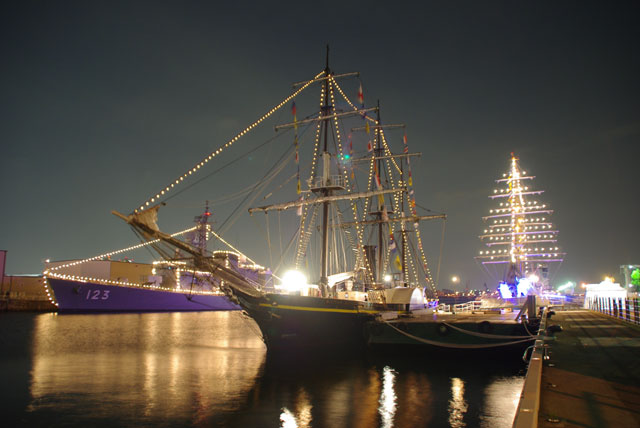 Since the EXPO is celebrating the opening of the port, the event's main galleries and exhibits are shown at the "sea section." The exhibitions are further separated into three main halls; Y150 Forest of Beginnings, Y150 Tomorrow Park, NISSAN Y150 and Super Hi-Vision Theatre.
Each hall holds many different exhibits. Forest of Beginnings focuses more on the history of Yokohama city and how it developed into one of Japan's creative hubs.
 Tomorrow Park focuses on entertainment and Yokohama's visions of the future. Here you can see a special sci-fi short film produced just for the event as well.
 Last but not least, the NISSAN Y150 Super Hi-Vision theatre focuses more on “experiencing” the future. Visitors can get a hands-on experience with the futuristic Nissan car, Pivo 2, in addition to a new hi-vision home theater program.
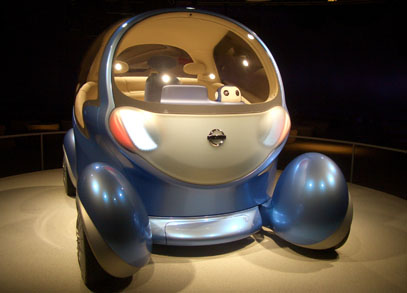 After exploring the "sea area," the city area will guide visitors through the usual tour sights of Yokohama. For the event, local businesses and citizens have also become very involved, tying up their products and shops with the whole event. As a result, most stores and restaurants offer discounts/or gifts when you present your tour map or entry ticket.
Furthermore, the Hillside will open in July and will feature the "nature" exhibits. The theme of this section is to connect people to people, people to nature, and people to the earth.
The EXPO's overall mascot is called "Tanemaru," who is a combined creature, made of half seed and half ship. This character is said to represent the camphor tree planted in the Yokohama's courtyard in 1859, which explains the choice of this unique looking mascot.
 The entire EXPO Y150 event will be open until September 27, 2009. I guarantee it would be a fun and educational experience about both the history and future of Yokohama, so head on down there to see the wide variety of events that would cater to guests of all ages and nationalities!
Saturday, June 27, 2009
Miyajima Part Two -Itsukushima Shrine-

You can never describe the beauty of Miyajima without mentioning Itsukushima Shrine!

Despite being a shrine, the most famous structure out of the many in the Itsukushima Shrine area is the Ootorii (The great guard frame). This Torii is widely known as one of Japan's most important cultural assets and is now the 8th generation gate, after being rebuilt numerous times since it was first constructed in 1875. It is 16.6 meters in height, weighs approximately 60 tons, and is made out of camphor tree wood that is about 500 to 600 years old—an age that can surely be felt firsthand through the gate's aura. Since the Ootorii is so large in size, and is painted in a bright, catchy vermillion color, you can even see it from the ferry to Miyajima island.
When the tide is low, you can walk from the main shrine to the Ootorii and pass under the great gate. On the other hand, when the tide is high, you can pass under the gate on sightseeing boats. I recommend researching when the tide is both high and low in advance so that you can enjoy the great gate in many ways. However, regardless of time, the Ootorii of Itsukushima Shrine is definitely a great piece of art that one should see at least once in their lifetime.

The main shrine is also an outstanding construction that is both splendid and exquisite. Walking down the shrine's wooden aisles makes you feel as if you have slipped back in time. Also, because the shrine is built along the shore, when the tide is high, it seems as if the whole building is floating on water. It's not uncommon to see water squirting out of the small crevices between the wooden boards that make up the aisles of the shrine. Numerous twists in architecture seen in the shrine protect the structure from the force of water, however, nature is no doubt strong. Like the Ootorii, the shrine has been rebuilt numerous times due to damages from natural disasters, but is still loved and respected by many people today.

Another aspect that makes the atmosphere of the Itsukushima area special is the presence of wild deer that dwell around the shrine. Deer that roam around the Miyajima area are very well adjusted to humans, and often come close to tourists looking for food. Deer being deer, they could be stubborn and uncooperative at times, but the way they match the scenery of Itsukushima Shrine and the surrounding constructions give an outstanding and unforgettable flavor.
Itsukushima's shrine has a history of over 1400 years, and out of thousands of other beautiful sightseeing spots, is definitely one of the most recommended places to visit in Japan. Once you see it, the powerful vermillion of the Ootorii is permanently seared into your head and you will never forget the beauty of the area.
But despite all I've said, it's nearly impossible to put Itsukushima Shrine's allure in words! So do yourself a favor and visit Itsukushima, and you'll understand why it's registered as a World Heritage Site and is loved by thousands of people all over the world!!

*Entrance fee to the Itsukushima Shrine is JPY 300 for adults, JPY 170 for high school students, and JPY 150 for elementary and junior high school students. Opening hours are 8:30 AM to 5:00PM.
Miyajima Part One -Omotesando -

A mere 10 minute-ferry ride from Miyajima Station will bring you to an island just off the coast of the Seto Inland Sea. That small island is Miyajima, also called Itsukushima. Chosen as one of the Nihon Sankei (Three Most Beautiful Spots of Japan), the island's beautiful scenery will surely satisfy any visitor.
As soon as you get off the ferry, turning right will first take you to Omotesando, a small shopping avenue (yes, it bears the same name as the popular fashion street in Tokyo, but of course it's something different.). There, hundreds of souvenir shops are located. Today, I'll introduce to you some of the most interesting don't-miss-sights that you can enjoy in Omotesando!

First of all, I recommend you to see the giant shamoji (rice scoop). In the 18th century, a shamoji was created in Miyajima as a souvenir for visitors and selling them helped the residents of the island economically. Ever since, Miyajima has been the most famous place in Japan for shamoji. In Miyajima today, the world's largest shamoji is displayed in the middle of Omotesando! That shamoji, also called the "Ooshakushi" (Giant Rice Scoop) is 7.7 meters wide, 2.7 meters tall and weighs 2.5 tons. It is said to have been created from a 270 year old zelkova tree, and has been placed in its current location ever since Miyajima was recognized as a World Heritage Site in 1996. The shamoji symbolizes not only the classic traditions of Miyajima, but also the hope to carry on the torch for future, making the giant rice scoop a well respected icon in the area. I'm sure you'll surely be surprised to feel how much power the shamoji truly exudes.

After left feeling astonished from the large shamoji, there is one more aspect that I recommend -gourmet!!-. First up, oysters! As you walk across Omotesando, you will see numerous shops that are grilling fresh oysters on nets and the scent that fills the air naturally attract customers! Buy one, pick it up with a toothpick and brace yourself for the great taste! Another gourmet I recommend is Anago (conger). They are also grilled on nets and are then dipped into a special sauce. The best way to enjoy it is to put them atop rice bowls and enjoy them as a domburi. You can find many anago-don diners in Omotesando as well, so don't hesitate to judge for yourself!
Omotesando is only a tiny part of the ways to enjoy Miyajima, but now that you know, it's definitely a must-visit location!
Wednesday, June 10, 2009
Osaka Castle
 Osaka Castle, also known as Osaka-jo, was constructed by Toyotomi Hideyoshi, and is located in current Osaka's Chuo-ku. This modern-day landmark played a major role during the Azuchi Momoyama Era in the sixteenth century. The castle is built on a landfill platform, supported by cut rocks. This way of building is called "Burdock piling," named after the similar looking Japanese burdock plant. The castle itself is eight stories high, and today the inside has been transformed into a museum with artifacts and weapons on display.
Now, the castle is open to the public and anyone can enter with tickets. As you walk into the castle, you're greeted by a super-modern lobby, which resembles that of high-class hotel rather than a museum. While sleek and beautiful, the lobby left me with a mixed feeling of regret and yearning for a traditional atmosphere, but I also admit I welcomed the I-can-definitely-use-the-restroom-here relief! (I can't help feeling that restrooms at historical locations tend to be quite dirty...)
The view from the top of the castle on the 8th floor is breathtaking, and makes you imagine what Toyotomi Hideyoshi may have been thinking as he looked down at the city from there.
Osaka Castle is located in the middle of Osaka-jo Koen (Park) and is a leisurely 15-20 minute walk from Osakajokoen Station or Tenmabashi Station. It may sound long to walk for 15 ~ 20 minutes, but the park is filled with beautiful greenery and many other things to look at, so you'll be there before you know it!
Saturday, June 6, 2009
Toshimaen [Wiiii]
 Just by taking the Seibu Ikebukuro Line from Ikebukuro Station, you can take yourself to one of the most famous amusement parks in Tokyo! That amusement park is called Toshimaen and it is definitely an enjoyable place to spend the upcoming summer days!
As I mentioned, Toshimaen is an amusement park - so of course there are rides and attractions that can be enjoyed! However, there is something much better in Toshimaen that I truly recommend to you – the abundant pools! There are giant wave pools, pools with rapids, pools with waterfalls, pools for competitive swimming, and regular pools that can be enjoyed by people of all ages – with families, friends, and even with your loved one!
There is more than swimming to amuse yourself with at Toshimaen - enjoy the water slides! The water slides are called "HYDRO POLIS". Toshimaen possesses four types of water slides which are also the biggest slides in the prefecture. One type of water slide is the thrilling type. It does not have a snake-shaped path, so you fall straight down with full speed from a height of 22 meters! Other types of water slides to be enjoyed are a tube slide and others that wiggle left and right. Although it takes quite a lot of climbing to get to the top of the water slides, it will fill your heart with excitement.
The water slides here at Toshimaen are among the most famous and most popular water slides in Tokyo; so they are definitely worth experiencing! Why not go to Toshimaen and start your summer off with a splash!
*Entrance fee for the swimming pools at Toshimaen is JPY3800 for adults, JPY2800 for children 110cm and above in height, and JPY1800 for children 110cm and lower in height. Please keep in mind that people with noticeable tatoos will not be accepted into the pool.
Thursday, May 28, 2009
Tokyo Daijingu - Love Luck in Japan! [Pray]
 Looking for some romance? Want to ask the gods of Japan for help and support in your love life? If you do, then there is only one place to go - Tokyo Daijingu! This popular shrine in Japan is famous for making your love life work out just the way you want it to.
Tokyo Daijingu first came to Tokyo in the Edo period. The Meiji Emperor wanted a satellite shrine of Mie Prefecture's Ise Shrine in Tokyo, so he had one built in Hibiya. Later, Tokyo Daijingu moved to where it is now – Iidabashi - after the Great Kanto Earthquake in 1923. Ever since then, it has been a famous shrine in the urban Tokyo.
Tokyo Daijingu is also the birthplace of Shinto-style weddings. The first Shinto-style wedding was held by the emperor in 1901 (before then, weddings were normally held at homes). Since that event, having weddings at a shrine has become a popular custom that is still continued today. If you are lucky, you may be able to see a wedding on the day you visit the shrine! The elegance of the wedding at Tokyo Daijingu is very unique, so it is an occasion to behold.
What I also recommend that you do at Tokyo Daijingu is to buy an Omamori (good-luck amulet). They can be purchased at the shrine and are very popular among young people (especially women) in Japan. There are types that can be worn on to your mobile phone or placed in your wallet, so you can take your luck around everywhere you go. If you do so, you may find your destined soul mate right away! Even if you already have a partner, there are also Omamoris for couples, so wearing them may be certain to make your love last forever!
Visit Tokyo Daijingu! I truly hope your love life will go well!
Thursday, May 14, 2009
Asakusa
 Asakusa is one of the most popular places for tourists visiting Japan and is surely a must-go! You can see and experience artifacts in this temple town which flourished during the Edo period.
Kaminarimon
Kaminarimon is the gate standing before the Sensoji Temple with a huge red lantern hanging in the middle. Kaminari means "thunder" in Japanese and mon means "gate." The gate was built by Taira-no-Kinmasa in 942. On both side of the lantern are two statues inside, called Fu-jin and Raijin, a God of wind (Fu-jin) and a God of thunder (Raijin). The lantern itself is about 4 meters tall and weighs about 670 kg.
Nakamise Dori
Nakamise Dori is the street leading to the Sensoji Temple from the gate. It was first formed in 1685 and the street is about 250 meters long, starting from the Kaminarimon to Hozomon. It has about 90 stores lined up, selling teas, crafts, foods and kimonos and of course various souvenirs. Since the street is narrow it is usually crowded with so many people either from Japan or outside Japan.
Sensoji Temple
Sensoji Temple is one of the oldest temples from the Edo period. Over the centuries since then, it has attracted many people, and became the center of the entertainment and commercial industry.
Due to its longevity, Sensoji Temple has been hit by earthquakes more than ten times throughout its life and is constantly being rebuilt. During the air raids of Tokyo in 1945, the entire temple was burned down. More recently, it was rebuilt in 1958.
When entering Sensoji, you will see a bronze pot where tons of incense is being burned. The smoke is said to possess divine power and to give good luck to people. Many visitors try to cover themselves with as much smoke as possible to banish any bad luck and bad health.
Jinrikisha (Rickshaw)
When you get off at Asakusa station, you may see guys wearing black tights and white tabi (Japanese socks) waiting by a carriage. These are the jinrikisha, a service where they pull you in the carriage around Asakusa and tell you historical stories while you ride. It might be a little pricey at 13000 JPY a ride, but is an experience you could only get in Japan and is definitely worth it.
Stroll around the Nakamise Dori, take a ride on rickshaw, seeing Japan through Asakusa is another way to enjoy one of your stay in Japan.
Friday, May 8, 2009
Date in Chiba (Around Tokyo)
Chiba is the other neighbor of Tokyo, known for the Disney Resorts at Maihama station. Whether you are newlyweds or newly-coupled, the Maihama area of Chiba prefecture is the best place to go.
For new couples, who need to get to know each other more:
The best place to go is Disney Land. Since the amusement park itself has so many attractive places and topics to talk about, you will be friends with him or her in no time! If you're lucky enough, you might be able to take pictures together at the amusement park.
Another thing is that in Japan, there are two Disney theme parks. We also have Disney Sea, which is a water-themed amusement park based upon cities and Disney characters from around the world. They have an Indiana Jones ride, Aladdin shows, and the Little Mermaid land where you can enjoy the fun and fantasy of Disney.
 After enjoying the fun, IKSPIARI is the place to be! It's located right between the Disney theme parks, which has both fast food and some a-bit-luxurious-restaurant vibe that is good for a first date. They also have nice cafes where you can catch a cup of coffee. Now you will know each other a bit more than when you first met up at the station.
For the couples who have been dating for a while and want to refresh their relationship:
 Maihama, Chiba is a great place to go for couples who has been dating for quite a while. Since it takes time to get there, it will be a refreshing break from the daily routine. When arriving, go to the North exit of the station and you will see the free shuttle bus stop to the Eurasia (Spa Land). Yes, I guess all of you realize by now that I'm taking you guys to a Spa. This whole date's goal is to freshen up your relationship and each other. To do that, this is the place to be.
Eurasia is a 10-story spa relaxation building, with many Jacuzzis, saunas, massage booths, rooms to stay overnight (hotel), and restaurant - all in one building. You can spend a day here and relax all you want for a really cheap price. It's the closest get away if you are living in Tokyo and a great get away for anyone visiting Japan as well.
By relieving the stress you have built upon each other, you might be able to look at each other once again to express your love.
When you are tired of just relaxing and want fun and excitement, you can always go to Disney Sea, Disney Land, or IKSPIARI! That's why I recommend a Maihama, Chiba date! You can alternate your plan any way you want so that there are no more arguments on where you want to go, or what you want to do or eat!
For new couples, who need to get to know each other more:
The best place to go is Disney Land. Since the amusement park itself has so many attractive places and topics to talk about, you will be friends with him or her in no time! If you're lucky enough, you might be able to take pictures together at the amusement park.
Another thing is that in Japan, there are two Disney theme parks. We also have Disney Sea, which is a water-themed amusement park based upon cities and Disney characters from around the world. They have an Indiana Jones ride, Aladdin shows, and the Little Mermaid land where you can enjoy the fun and fantasy of Disney.
 After enjoying the fun, IKSPIARI is the place to be! It's located right between the Disney theme parks, which has both fast food and some a-bit-luxurious-restaurant vibe that is good for a first date. They also have nice cafes where you can catch a cup of coffee. Now you will know each other a bit more than when you first met up at the station.
For the couples who have been dating for a while and want to refresh their relationship:
 Maihama, Chiba is a great place to go for couples who has been dating for quite a while. Since it takes time to get there, it will be a refreshing break from the daily routine. When arriving, go to the North exit of the station and you will see the free shuttle bus stop to the Eurasia (Spa Land). Yes, I guess all of you realize by now that I'm taking you guys to a Spa. This whole date's goal is to freshen up your relationship and each other. To do that, this is the place to be.
Eurasia is a 10-story spa relaxation building, with many Jacuzzis, saunas, massage booths, rooms to stay overnight (hotel), and restaurant - all in one building. You can spend a day here and relax all you want for a really cheap price. It's the closest get away if you are living in Tokyo and a great get away for anyone visiting Japan as well.
By relieving the stress you have built upon each other, you might be able to look at each other once again to express your love.
When you are tired of just relaxing and want fun and excitement, you can always go to Disney Sea, Disney Land, or IKSPIARI! That's why I recommend a Maihama, Chiba date! You can alternate your plan any way you want so that there are no more arguments on where you want to go, or what you want to do or eat!
Subscribe to:
Posts (Atom)
Related Posts
