 It’s cold right now, but the winter has just started... And everybody is eating "nabe" –a Japanese style pot where many people eat by surrounding it and sharing the food. Everybody knows nabe and it is a typical Japanese food so here I am to introduce another Japanese winter food which will warm you from inside out! Oden! You might see them being sold at many convenient stores but it doesn’t have to be store-made, you could make it at your house on your own!
Showing posts with label season. Show all posts
Showing posts with label season. Show all posts
Tuesday, January 12, 2010
Oden
It’s cold right now, but the winter has just started... And everybody is eating "nabe" –a Japanese style pot where many people eat by surrounding it and sharing the food. Everybody knows nabe and it is a typical Japanese food so here I am to introduce another Japanese winter food which will warm you from inside out! Oden! You might see them being sold at many convenient stores but it doesn’t have to be store-made, you could make it at your house on your own!

Friday, December 4, 2009
SUSUBARAI
 As the year winds down and Christmas lights illuminate the evenings, Japan prepares for the next month's festivities as they welcome the New Year.
 Friday, November 20, 2009
No turkey on Thanksgiving?
It’s November, the time of football and best of all, turkey!! But they don’t have that custom here in Japan…
 When you think of Thanksgiving, if you are from the states, you’ll probably think of pilgrims and Indians having a big festival and dining on a huge meal. Like roasted turkey and cranberry sauce lining up on the table with pumpkin pies and mashed potatoes glazed with gravy…ooh just typing these makes my stomach growl…
 When you think of Thanksgiving, if you are from the states, you’ll probably think of pilgrims and Indians having a big festival and dining on a huge meal. Like roasted turkey and cranberry sauce lining up on the table with pumpkin pies and mashed potatoes glazed with gravy…ooh just typing these makes my stomach growl…
Saturday, November 14, 2009
When Tokyo Lights Up…
Tis’ the season to be jolly, and tis’ the season Tokyo starts to become filled with glimmering lights of illumination. Tokyo bustles with holiday illuminations during Christmas season. Many of these illuminations start to light around this time of the year, until as late as Valentine’s Day.
Here are some of the beautiful seasonal lightings around Tokyo:

Shiodome:
Instead of the red and green lights, Caretta Shiodome centers on the theme of “ocean” for the holiday lighting. Splendid fields of blue illuminations will surround you and amaze you this winter.
Displayed from: Dec. 1 – 25, 2009
Here are some of the beautiful seasonal lightings around Tokyo:

Shiodome:
Instead of the red and green lights, Caretta Shiodome centers on the theme of “ocean” for the holiday lighting. Splendid fields of blue illuminations will surround you and amaze you this winter.
Displayed from: Dec. 1 – 25, 2009
Friday, November 13, 2009
Tori no ichi
 Tori-no-ichi is the traditional Japanese open-air market which takes place on the day of the rooster (tori-no-hi, tori meaning bird or here rooster) in November according to the Chinese calendar. And as for this year it is November 12 and 24, 2009.
 Monday, November 9, 2009
EXCLUSIVE AUTUMN TASTE
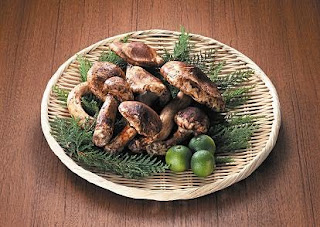 There are many expensive foods around the world, caviar, foie gras, saffron, white truffles, you name it. And there are so many to name just in Japan too, such as Yubari melon, the famous Kobe beef, and fugu (blow fish). But do you know what the most favored expensive food is during autumn in Japan? It is the matsutake mushroom.
Thursday, October 8, 2009
HUNTING
 When you hear the word "hunt" the first thing which pops up in our mind is either fox or deer or any type of animal living in a forest right? The word "hunt" just automatically links you to a violent idea. But, here in Japan we hunt for something else. No blood, no gore, no weapons needed. Cause here in Japan we hunt for fruits and vegetables.
Tuesday, August 18, 2009
Hanabi Taikai -Fireworks Festival-

When summer comes, people of various ages in Japan are excited for Hanabi Taikai as Hanabi, or fireworks, symbolizes summer. Hanabi Taikai are firework festivals which occur almost every weekend, especially Saturdays, during mid July to mid August. It is a night event about 2 hours long, where tens of thousands of people gather to watch fireworks one after the other shot into the sky. Many like to wear yukatas to watch fireworks as it brings up the fun and mood. People never get tired of going to Hanabi Taikai as fireworks are always various in colors, shapes, and designs. Families enjoy Hanabi Taikai as they bring family bonding time while watching and voicing their favorite ones. Love birds usually go to Hanabi Taikai for dates, as holding hands and looking at the beautiful fireworks brings about butterflies.

Sumidagawa Hanabi Taikai, Aomori Hanabi Taikai and Sendai Tanabata Hanabi Maturi are some of the famous Hanabi Taikai that are well-known and popular to the Japanese citizens. However, there are thousands of these events throughout Japan that are as good, so it is worthwhile to attend to one when you have a chance. Some Hanabi Taikai you can attend in Tokyo are Sumidagawa Hanabi Taikai (July 25, Asakusa Station), Tokyo Wan Dai Hanabi-sai (August 8, Kachidoki Station), Chofu-si Hanabitaikai (July 18, Cho-fu Station), Edogawa-ku Hanabi Taikai (August 1, Edogawa Station), Setagaya Tamagawa Hanabi Taikai (August 22, Futakotamagawa Station), and of course, there are much more.
Friday, May 1, 2009
Children's day Part 2 - Kabuto and Kashiwa-mochi
 Koinobori is not the only fascinating aspect of Kodomo no hi (Children's Day) in Japan. This time, I will show you some other ways people enjoy the holiday.
As I have mentioned earlier, Children's Day is a day when boys are the star. In addition to Koinobori, Japanese people prepare a Kabuto arrangement (Armor) in their houses. Kabuto can be easily described as an ornate helmet worn by Japanese warriors centuries ago, were an essential item during war. In other words, it was an important item to protect their lives. Thus, today on Children's day, people like to place a Kabuto in their house so that the boys in the house will be protected from accidents and disasters. It also is placed so that the boys will become a great man when they are a part of society. This custom has been practiced in Japan since the Edo period (1603-1867). Although they are very expensive today, people like to buy the Kabutos (miniatures) of famous warriors because they each differ in design. For those who do not care and just want them for decoration, regular Kabutos are available as well. Kabutos are also popular because you can make the helmet in origami (folded paper). If they are made with large sheets of paper, children can actually wear them on their head and can enjoy the holiday to the greatest extent!
Several different foods are enjoyed on this day as well. The first is fish. In Japan, there are numerous fish that are named differently as they grow. For example, mullets (most often called bora), change their name five times depending on the stage of life it is at (Oboko-inakko-subashiri-ina-bora-todo). Japanese amberjacks (most often called buri) are another example as well. Japanese people believe that eating these fish is good for advancement in life. Also, Kashiwa-mochi is enjoyed among the Japanese as well. Kashiwa-mochi is a popular Japanese confectionary made by wrapping mochi (rice cake) in a kashiwa leaf. This is popular on Children's Day is because kashiwa leaf has an important meaning. That is that kashiwa leaves do not fall until a new sprout appears. Thus, this symbolizes the continuation of the family. On Children's Day, Japanese people enjoy eating kashiwa-mochi so that their family tree will continue on to further generations.
As you can see, there are many interesting customs for Children's Day in Japan that has very unique origins. Knowing them will sure let you enjoy the holiday even more. So, now that you have learned the interesting things you can see and eat on Children's Day, all you can do now is get prepared and wait for the day to come!
Monday, April 27, 2009
Children's day Part 1 - Koinobori
 When May is just about to come, you may see people putting up flag-like fishes outside of their homes or inside buildings. That is called a Koinobori. Designed on a large piece of fabric (usually nylon), its etymology means "climbing (nobori). carp (koi)". Let's see why this fluttering fish is so important during this season and what it means in Japan.
Just as girls' day is celebrated in March (Hina Matsuri), there is also a day for boys called a "Kodomo no Hi" (Children's Day). On May 5th, boys are the star of the day. But why a carp? Carp are said to have strong life energy and can live in different areas. Also, they appear in numerous ancient legends as strong characters. That is surely why Koi (carp) are s such an important symbol for this day! The carp put up to sway along the streams of wind look powerful and strong; making their way up the sky. By representing the strength and courage of the carp, parents wish for their boys to grow up with these traits. It also is a message to the gods, asking them to bless newborn baby boys. Usually, the black carp is the father, the red carp is the mother, and the smallest one on the very bottom is the child. However, the colors are not too important and you can see many different and colorful varieties of Koinobori. The object above the father is there to protect the family from evil.
One area where you can view beautiful Koinobori in Japan is at Tatebayashi, Gunma Prefecture. Along the Tsuruudagawa river, which is a 20 minute walk from Tatebayashi Station, the "World's Greatest Village of Koinobori Festival" is held every year. As the festival with the greatest number of Koinobori put up (5283), it was registered in the Guinness Book of World Records in the year 2005. Today, thousands of Koinobori are put up when spring is about to come. When a spring breeze blows through the air, the Koinobori dance along with the wind; makes it look as if they are actually swimming along the river. That sure is a beautiful sight to see!!
There are many other areas in Japan that have Koinobori Festivals (e.g. Tsuetate Onsen in Kumamoto, Sagamigawa in Kanagawa, Ryujin Otsuribashi in Ibaraki); so what are you waiting for? Go get some courage and strength from the carps swimming in the air!
Thursday, March 19, 2009
HANAMI
 Bonenkai was about three months ago - so it's almost time to go crazy and wild and drink again with friends in Japan. The season of cherry blossoms is coming up and that might be the best excuse to celebrate!
The word "Hanami" literally means "to watch / view flowers" but it also means to drink and have a party underneath the sakura (cherry blossoms) trees and not any other flower. Some people like to just take a walk or take pictures of the cherry blossoms too, but most people like to party instead.
Most popular place to party in tokyo is known to be Ueno Park. The whole park will be filled with cherry blossoms and loud partiers. They will have food stands in the park as well. So if you and your friends are planning to go crazy, then wild Ueno is the place to be! Also since you are at Shinobazu Lake, you can enjoy the sakura from boats too.
Another place where you can enjoy hanami is Inokashira Park in Musashino City. Many University students have their hanami party here since there are many Universities near this area. The park has a pond in the center and you can enjoy viewing the sakura trees surrounding the pond from pedal boats as well - just as it is in Ueno.
A different way of enjoying sakura is by taking a walk and watching these beautiful flowers. Some major places where people frequent are by the Meguro River and by the Sumida River.
Meguro River
Get off the train at Meguro or Naka Meguro station and take a walk down by the riverside. There are a remarkable numbers of cherry blossoms. The best time period to see the blossoms is around noon as the sunlight highlights the color of the flowers. Another good time are the weekends during the hanami period; but because it gets very crowded, it might be best to just take a walk spontaneously instead of going on the weekends when there are many people.
Sumida River
Get off at the JR or subway line at Asakusa or Asakusabashi station and take a walk down by the Sumida River. The river boat starting from Hamamatsucho is also very popular during this season. There are some spots where many homeless people live by the Sumida River, but in general, these homeless people won't be bothering you. The cherry blossoms by the river are very beautiful, so it is worth going there. 'Tis the season of sakura and hanami, so gather your friends and family and have a nice day outside in the park. Eat, talk, and have some drinks outside with your loved ones!
Sakuramochi - A Spring Snack for Everyone
 When spring is just around the corner, many Japanese people enjoy eating Sakuramochi -a traditional "wagashi" (Japanese confectionary). When visiting Japan in the spring, you may see Sakuramochi in many places. This time, I will offer you with some basic information about Sakuramochi.
A typical Sakuramochi is anko (bean paste) wrapped in dough that is wrapped once again with a brined cherry blossom leaf (as seen on the picture). This confectionary has been eaten since the 1700s and there are two types of them. One is called Chomeiji (Kanto Style) and the other is called Domyoji (Kansai Style).
The differences between the two are the ingredients used to make the mochi's pink dough and its shape. Chomeiji Sakuramochi are made using regular flour and usually shaped like waffles. On the other hand, Domyoji Sakuramochi are made using a special powder called Domyoji powder and shaped like a straw rice bag. Domyoji powder is steamed mochi-gome (sticky rice) that is later dried and ground. It is different from other mochi because of its lumpier texture. In eastern Japan (Kanto Area), Chomeiji Sakuramochi is more familiar to people and is also sold in convenience stores. In western Japan (Kansai Area), people are not familiar with the Chomeiji Sakuramochi and prefer the Domyoji Sakuramochi instead.
Surprisingly, most people do not even know that there are two different types of Sakuramochi. Recently, however, it is not difficult to find a Domyoji-style Sakuramochi in the Kanto area.
Another interesting fact about Sakuramochi that is common in all areas of Japan is the use of brined cherry blossom leaf. Although it is not popular, those who like it say that the saltiness of the cherry blossom leaf complements the sweetness of the anko that is inside. This varies between people, so go ahead and taste one yourself!
Why not enjoy a nice hanami (cherry blossom watching) with a delicious sakuramochi as a snack??
Thursday, February 19, 2009
Monkeys in the Hot Springs
 What image do you get when you think of monkeys? Jungles? Rainforests? In Japan, there is a way you can enjoy their company in a completely different way. See them take a nice warm bath in the hot springs!
In Nagano there is a park named Jigokudani Yaen Koen (Jigokudani Monkey Park). Opened in 1964, the park is a facility made especially for tourists to enjoy watching the Japanese Monkeys bathe. This place first became popular as a place where people would feed the wild monkeys who lived here. Usually, monkeys do not like getting themselves wet; but the monkeys in this area started taking baths after watching a human take one. Now there are hot springs made exclusively for monkeys and they have become one of the most entertaining spectacles to see - attracting nearly 100,000 people every year. In the hot springs, some monkeys groom each other while others just like to sit still and do absolutely nothing at all. Whatever they do, they all look happy and relaxed. Watching them is a heartwarming and pleasing sight.
Nowhere else can you have the chance to see monkeys enjoying a warm bath! Although there are several rules that you must follow when visiting the sight, (i.e. do not feed them, do not touch them, do not talk to them, etc.) you will never forget this wonderful experience. Admission to Jigokudani Yaen Koen costs JPY 500 for adults and JPY 250 for children.
Hina-Matsuri
 Sorry to the boys, but in Japan, there is a day where people feast just for the girls! Called Hina Matsuri, it is held on March 3rd every year. It is also known as Momo no Sekku (the seasonal festival of peaches) and has been celebrated for centuries.
It was during the early Edo period (1603-1867) that the Hina Matsuri custom began. The emperor at the time played with a Hina doll (a girl doll) to entertain his daughter. Later, a general named Tokugawa Iemitsu gave his daughter a Hina doll as a birthday present. Since then, the custom of giving a Hina doll to every girl born was started. Now the custom of giving girls a Hina doll no longer survives. However, Hina Matsuri is still a special day for all girls in Japan.
On Hina Matsuri, many families in Japan celebrate the day by eating Chirashi-zushi. Chirashi-zushi is vinegared rice topped with tasty foods such as eggs, shiitake mushrooms, carrots, burdocks, and shrimp. Another way of celebrating, and the most popular one, is to set up a Hina ningyo (Hina doll). It usually has seven stairs and its beauty is outstanding. Here is how you set up each step.
(Top to Bottom)
1st step: Hina-sama and Odairi-sama. Odairi-sama is Hina's husband. He is usually placed on the left, and the Hina sits on the right. A paper lantern called a Bonbori is placed on each end and a peach tree is placed between the two dolls.
2nd step: Sannin Kanjo (The three court ladies). The two court ladies on the outside are standing and holding a sake bottle. The one in the center is sitting with a Shimadai (drinking cup).
3rd step: Goninbayashi (The five court musicians). Five men sit evenly spaced, each holding an instrument in their hands.
4th step: Two Ministers, rice cakes and a tray. Two Ministers are placed on each end and the rice cakes and the trays are placed between them.
5th step: Three servants and two trees. A mandarin orange tree and a cherry blossom tree are placed on each end. The three servants in the middle each have different expressions. One is crying, the other is laughing, and the last one sits with an angry face.
6th Step: Tools. Tools such as a wardrobe, an incense container, and a book holder.
7th step: Ox wagon, multitired box and a carriage. Each is placed evenly on the lowest step.
Usually, the Hina ningyo is made of seven steps. However, because some houses are not big enough to place this, some Hina ningyos are made of fewer steps. Although Hina ningyo are somewhat expensive, some are handmade and cost over JPY100,000, its beauty is always a pleasure to enjoy. Why don't you look for a Hina ningyo of your own and wait for the spring to come?
Tuesday, February 3, 2009
Valentine's Day & White Day in Japan
 Valentine's Day in Japan is quite unique. Unlike Valentine's Day in the United States, where men give gifts to women, women give gifts to men! It's completely the opposite! The custom of Valentine's Day in Japan started in the 1950's. Department stores began a Valentine's Day sale selling heart-shaped chocolates with signs which said "To men from women". Since then, numerous chocolate producing companies began selling more and more chocolates made especially as gifts for Valentine's Day.
It is not surprising to find an empty rack of chocolate bars at supermarkets on the days before Valentine's Day. That, of course, means that the day before Valentine's Day is a very busy day for women in Japan. There are two types of chocolates that Japanese girls and women give as a gift on Valentine's Day. One is "Giri-Choco" which means "Chocolate out of courtesy". This type of chocolate is given to men you treat as a friend. Usually, cookies or small chocolates are distributed to your usual friends, colleagues, bosses, etc.
The other type of chocolate is the important kind. It is called "Honmei-Choco" and is a chocolate gift given especially to the one you truly love. Women usually make chocolate cakes or an assortment of truffles and wrap them in beautifully decorated boxes. With the handmade "Honmei-Choco", some women show their appreciation for the ones they love, and some girls take their big step to tell their crush their true feelings! Valentine's Day can definitely be said to be one of the most exciting days for men, but a very nervous day for women in Japan! Ladies, it's almost the big day! Good luck!
White Day
White Day (March 14th) is a day that was created in Japan. It is a day to appreciate the women who gave their love (chocolates!) to you on Valentine's Day. There are numerous stories that explain the origin of White Day, but the truth is still unknown.
On this day, men show their thanks by giving gifts of cookies and candies they have bought to the women who gave them gifts on Valentine's Day. Unlike the United States, it is not as popular to give them roses. However, if I were a girl, it is always exciting to receive gifts from well-meaning men. Now, this custom has been popularized among Asian countries such as Korea and Taiwan; and they are enjoying White Day as well. Gentlemen, your secret admirer may be preparing for your gift now, so don't forget to show your appreciation on White Day!
Wednesday, January 21, 2009
The Beginning of the Year in Japan: Setsubun
 In the lunar year, setsubun is counted as the New Year. To celebrate the New Year, people from the past created a ritual known as mame-maki to cleanse away evil spirits by throwing soy beans at them.
Mame-maki
Usually a man who was born in a year sharing the New Year's Chinese zodiac sign puts on a demon mask and runs around the house. If there is no one who fits, then the head of the house becomes the demon. When the demon is running around the house, everyone throw soybeans at him and yell: "Oni wa soto, fuku wa uchi" (demons out, good fortune in).
After the mame-maki, each person eats the amount of beans matching their age. Pepeol also eat eho-maki, a long rolled sushi eaten facing the lucky direction of the year. Every year, the direction is different depending upon the year's Chinese zodiac sign.
Wednesday, January 14, 2009
Seijin-shiki
 Coming of Age Day is a National Holiday in Japan to celebrate the Shin-Seijin's "New-Adults" (people who turn 20 on that year). This year, Coming of Age Day was held on the 12th of January for people who were born from April 1988 to March 1989.
There is long history to the current Coming of Age day. The holiday was established after World War 2 to encourage and celebrate the independence and birth of adults helping to construct the future of their country. Until the year 2000, Coming of Age Day was celebrated on the 15th of January. Today, it is celebrated on the second Monday of January.
Coming of Age day is a very important once-in-a-lifetime event for the new adults, especially for women. Women on that day wear a traditional Kimono called a Furisode. A Furisode is the most prestigious type of Kimono worn only by unmarried women and is unique in a way that it has very long wings. Although it takes two professionals to assist a woman in wearing a Furisode properly, it is definitely one of the most important pieces of art that express the beauty of Japan. On Coming of Age day, women wearing Furisode can be seen all over the cities. Men, on the other hand, mostly wear black or navy suits on the big day. However, the number of men who wear Hakamas (traditional Japanese clothing for men) has recently been increasing. Both women and men wearing such traditional clothes later attend the Coming of Age Day ceremony that is held in the district that they live in. There, the new adults not only listen to speeches made by the mayor, but also enjoy meeting their old friends.
Overall, Coming of Age Day can definitely be described as an important National Holiday in Japan.
Sapporo Snow Festival
 It doesn't snow much in Tokyo, but it does in Hokkaido! Up there, they are starting to prepare for the Sapporo Snow Festival coming up in February. The Sapporo Snow Festival is one of Japan's largest winter events. It has been attracting many visitors from Japan and abroad every year.
Many come to Sapporo to see the hundreds of beautiful snow statues and ice sculptures which line up along the walkways of Odori Park, the Community Dome Tsudome, and the main street in Susukino. The statues and sculptures are made with tons and tons of snow. It does snow in Hokkaido but it doesn't snow that much! So where do they get the huge amounts of snow? Every year the snow is transported from fifteen locations in and around Sapporo between the beginning and end of January. Last year, the amount of snow transported for the festival was equivalent in volume to 7.490 five-ton truckloads.
Beginning in the late 1940s, this year marks the 60th Sapporo Snow festival. Every year sculptures are carved by many artists from all-around Japan. The artists direct military personnel and volunteers to carve the amazing snow masterpiece. Every sculpture and statue is breath-taking. They are made with the smallest details and they look so real, it's almost impossible to believe. Also, some sculptures portray the events that have taken place during the year. So for the year 2008, they are planning to display the gold medal winners from the Beijing Olympics.
It starts on February 5th, 2009 and ends on the 11th. It's only for a week and the admission is totally free! So what are you waiting for?
Juken
 The New Year has started and the morning rush is back. People are going back to the office and kids to school. Not everyone is very enthused to go back, but if you hear this schedule, you might feel a little better.
Mon: Cram School
Tue: Monthly EXAM
Wed: Cram School
Thu: Mid-term TEST
Fri: Cram School
Sat: Cram School
Above is an example of the afterschool schedule for a senior high school student in January. They go to normal school from morning to afternoon, and then they go to a cram school to study some more. So that they can get into the University of their Dreams, they go through "juken." Juken, is a way to get into a university in Japan. Students take tests as often as every two weeks, one big exam (called "Center shiken") in January, and a big entry exam for each university in February and March. Yes, it is a big deal in Japan, and many students suffer with the study.
As said in previous writings, Japan is a very superstitious country. When we feel anxiety or feel we need help, we go to temples or shrines to pray and buy lucky charms known as "omamori." This goes for the students going through juken too. They buy omamori and good luck supplies to comfort their anxiety. One of the best known shrines for education in Japan is the "Yushima Tenjin" near Tokyo University. The shrine worships Sugawara Michizane, a scholar and a government official in the Heian period (794-1192) known for his talent in education. Many students come here to buy omamori (lucky charm) and to wish themselves good luck.
Another thing in Japan is that many students buy "gokaku goods" around this season. In Japanese, gokaku means to pass an exam or another challenge. Many merchandise brands such as snacks, office supplies, and drinks, produce these goods. The students believe that by buying the gokaku version of the products they will feel more comfort than when buying the normal version of the products. These products will be lined up at the nearest convenient stores and supermarkets soon so if you have a chance, please try one out. Some products offer you a different flavor than the usual ones, or limited time pen colors and containers.
Monday, January 5, 2009
The Beginning of the Year in Japan: Omikuji
 An omikuji is a strip of paper with fortunes written upon it. You never know what's written inside, because it's all mixed up randomly. There's usually a box or a cylinder shaped box that one needs to shake and a chest with numbers written on each drawer. By shaking, a wooden stick from the bottom of the box slides out with a number on it. Then, you look for the drawer with that number written on it. Inside, will be your "omikuji" and it will have your fortune written on it.
There are usually seven results. They are:
Dai-kichi - excellent luck - The best result, great blessings.
Chu-kichi - Fair luck - Not the best but good enough.
Sho-kichi - Small luck - Could be better but you might bump into something nice. Rate definitely goes up.
Kichi - Blessing - Life may be normal yet there might be something special.
Sue-kichi - Near-blessing - Cloud be pretty close, but not good enough yet.
Kyo Cursed, bad luck - Not a great omikuji to pull out on New Year's or before promotion.
Dai-kyo Great curse, great disaster, the worst - If you pull this one out, I'd consider buying a life insurance policy ASAP.
If you pull out something nice like dai-kichi or chu-kichi, you could take the omikuji strip with you. It is said that the omikuji paper will protect you from bad spirits and lead you to the good way. But if you pull out something bad, or a result you are not very happy with, then you tie it around the pine tree in the shrine. In Japan it is said that by pinning the unluckiness onto the pine tree, the spirits will stay there and won't come near you.
Comparing your results with friends or family is always fun too. It's part of the omikuji's fun to predict each other's year and how it will go.
Subscribe to:
Posts (Atom)
Related Posts
