Just like other facets of contemporary Japanese culture, the sports scene in Japan is an interesting blend of games and activities from both Japan and overseas.
Probably the largest spectator and commercial sport in Japan today is baseball though in recent years soccer has been increasing in popularity. Baseball is typically known as yakyuu in Japan. The term literally means “field ball.” It was a term coined when the game was introduced by an American English professor in the 1870’s. By 1920 the first professional baseball league had started in Japan and from then on it quickly became a national past-time. High-school tournaments, such as the one held in Koshien each year, have become iconic. Many teen-aged Koshien participants have gone on to become professionals in Japan and the USA.
As mentioned earlier soccer is also a very important sport in Japan. Soccer was first introduced to Japan around the same time as baseball. Despite being a hugely popular international game, the sport never really gained a lot of interest in Japan until the 1960s when Japan won an Olympic bronze medal in the sport. Since then soccer’s popularity has snowballed until in the early 1990’s the professional “J-League” was formed. In 1998 Japan made its first appearance at the soccer world cup finals. The team didn’t win a game but its appearance at the tournament was seen as a huge sign that soccer was now a major sport in Japan. Interest in the game peaked in 2002 with Japan co-hosting the world cup with Korea. Earlier this year Japan recorded their first ever victory in a world cup tournament.
Traditional Japanese sports are still very important. The most popular Japanese sport by far is sumo. Sumo is hundreds of years old and today the sport is fully professional with approximately 700 registered professional sumo wrestlers affiliated with 54 stables. The sport is administered by the Japan Sumo Association. The top-most sumo division receives a huge live and television audience with the highest ranking yokozuna receiving great prestige and financial reward. Sumo can trace its origins to ancient Mongolia where wrestling has been a hugely popular sport for thousands of years. As a result the sumo leagues of Japan feature a number of Mongolian wrestlers. The most famous of whom being recent yokozuna Asashoryu and Hakuho.
Of course there are many more sports to watch and take part in in Japan. Here we’ve only touched on the top three. Joining a club or team is an important part of Japanese culture. Consequently, sports thrive in Japan. Team members and supporters are incredibly organized in their chants and cheers for their teams. If you can’t join a Japanese sports team, being a spectator is also a great experience.
Friday, August 20, 2010


Monday, August 16, 2010
Say Cheese!

If you are asked to think of stereotypical Japanese pursuits, you’d probably think of karate, origami, ikebana and so on. I’m sure though that I’m not the only one who thinks of photography. Japanese manufacturers are recognized to be some of the best producers of cameras and photography equipment in the world.
During the 1970’s and 80’s, when the Japanese economy was booming, it was quite common to see busloads of Japanese tourists in popular vacation spots around the world. One of the hallmarks of these tourists was their penchant for photography. Being home to companies like Canon, Fuji and Olympus meant that these tourists were always well equipped with the very latest cameras and technology.
These days the Japanese economy may not be what it once was, but the photography business is still big in Japan. If you’re a photographer of any level of proficiency, Japan is a must visit. Cameras and equipment abound in places like Akihabara, but you don’t have to go to Akihabara for the best deals. Most Japanese electronics stores carry a full range of cameras and camera equipment. The west exit of Shinjuku station is also famous for it’s mini camera district.
Photography in Japan isn’t just about camera shopping and technology. You will meet some of the most patient and dedicated amateur photographers here. Every weekend you will see keen photographers setting up their gear on train platforms waiting for a good shot, or even travelling miles into the countryside to secure a prime spot for the perfect sunrise or sunset. Visitors to Japan can be seen with camera in hand snapping such popular sights as: Shibuya crossing, Mt Fuji, Tokyo Tower and believe it or not, according to a recent survey, automated parking towers.
If you just want a cheap new digital camera or the latest SLR, Japan is the place for you. While you’re here you can test out that new camera on the many interesting sights and attractions Japan has to offer.
Thursday, August 5, 2010
All you can eat........and drink!

Perhaps it’s the fact Japan has been in an economic downturn for almost twenty years
now, or maybe it’s because Japanese people love to eat, drink and be merry, but there can be no mistake that affordable "all you can eat and drink" plans are extremely popular in Japan.
Tabehoudai (all you can eat) and nomihoudai (all you can drink) are the virtual
cornerstone of partying in Japan. Space is always at a premium in Japan so house
parties are almost non-existent. The result is that most Japanese people like to party it up in an izakaya (a Japanese style bar) or restaurant.
Izakayas and restaurants are everywhere in Japan and competition for customers is intense. As a result many izakayas offer affordable "all you can eat and drink" plans.
Such plans usually adhere to a strict time limit of two hours. During this time it’s as the name suggests; all you can eat and drink inside these two hours. Keep this time limit in mind as the time limit is usually very strict.
Staff will alert you twenty minutes beforehand so you can make last orders.
Most plans typically start at prices of two thousand yen per person for a simple
nomihoudai. A lot of izakayas have plans of three thousand yen per head for "all you
can eat and drink". Of course, these are the cheapest examples and it can sometimes be a case of “you get what you pay for", especially in large chain izakayas. For the
most part though these plans have decent quality. In more recent times, the "all you
can eat or drink" phenomenon has spread to certain restaurants too, most of which are yaki-niku (barbecue style) restaurants.
The old assumption of Japan being an expensive place to visit is not so true as it
once was.
Nomihoudai and tabehoudai are part of the culture and are only becoming more and more common in the current global economic climate.
Eating and drinking in Japan couldn’t be cheaper or easier as it is today.
All the Flavors Under the Sun

If you’ve ever stepped into a Japanese supermarket or convenience store, you would have noticed the vast display of drinks and confectionery. In fact, some of my favorite souvenir items I like to purchase for friends and family back home are snacks and confectionery. They are not only cheap and delicious, but incredibly varied.
Even a short stay in Japan will make it clear that the Japanese love food and drink. TV here is plastered with shows where people do nothing but eat local cuisines from around the country. It is so big of an industry, that food and drink manufacturers here spend an enormous amount of time and money inventing new product lines.
The beverage industry in Japan is a great example of this. Each year major Japanese beverage companies like Kirin, Suntory, Asahi, Coca-Cola and Pepsi flood convenience store shelves with a huge variety of “seasonal specialties” or limited edition flavored drinks. This year alone we’ve already seen African tea-flavored coke, white coke, green coke, slime coke, coke and orange mix, caffeine-free diet coke. And that’s just coke. There are dozens more flavors and limited edition runs for other beverages too. Many drinks often only sell for a month or so before they are replaced with the new “flavor of the month.”
One reason for such high turnover of product lines is that the industry is extremely competitive. Regular new flavors guarantee a sales spike for the initial period. Food and beverage companies in Japan produce a larger variety of product lines than any other country in the world, sometimes researching new recipes and ideas months or years in advance. Another reason is that the industry has by itself created a collectors market for new and limited edition snacks and beverages. Collectors race to buy these items as soon as they are released. Some items are so limited that they require a waiting list and command a high price.
Consumers in Japan have a busy time keeping up with all the new flavors of drinks and snacks each year. Every flavor under the sun is an expression that accurately sums up Japan’s ever changing convenience store display shelves.
Monday, July 26, 2010
Tokyo Sky Tree

Many Japanese can tell you that Tokyo Tower is taller than the Eiffel Tower, but that’s soon about to change. No, Tokyo Tower isn’t being cut down to the same size by the French, nor is the Eiffel Tower being extended. The reason is simply that a new tower is under construction in Tokyo.
“Tokyo Sky Tree” is the name of the soon to be the world’s tallest tower. When complete, it will stand at a height of 634 meters. This will be 24 meters higher than the second highest tower in the world, the Guangzhou TV and sightseeing tower in China.
Located in the north-eastern ward of Sumida, close to the popular area of Asakusa, construction of the Tokyo Sky Tree began a couple of years ago and at the time of writing it stands approximately 336 meters tall. This means that it has already become Japan’s tallest structure and it’s only half complete.
When completed, the tower will be used to broadcast an array of digital signals far and wide. TV and radio stations will make up the bulk of the tower’s broadcasting capabilities. Of course the tower will be a major tourist attraction. Visitors will be able to climb to a viewing platform and view the city from a height of 350 meters. Actually, despite being under construction, Tokyo Sky Tree has already become a major tourist attraction. Thousands of people flock to the site to take pictures of the incomplete structure.
Tokyo Sky Tree will have its grand opening in 2012. It can be easily reached from Oshiage station on the Hanzomon subway line.
Happy Mondays

Not the early-90’s band from the UK but the appropriate title for Japan’s national holiday/long weekend initiative.
Japan is blessed with a generous amount of national holidays. In fact, there are only one or two months in the year that don’t have at least one national holiday. A few years ago the government decided that as many national holidays as possible should fall on a Monday. Hence the term “Happy Mondays”.
Apart from offering a break to tired workers, the “Happy Mondays” idea is a great economic stimulus. The Japanese love to venture out into the countryside to sample the local cuisine and attractions of other areas. Purchasing unique snacks as souvenirs is a particularly big business in Japan. A steady flow of long weekends combined with heavily discounted highway tolls makes for a small economic boom.
The upcoming happy Monday , as this article is written, is “Sea Day”. Sea day takes place towards the end of July when rainy season has just about ended. The result is hopefully a day to spend by the seaside with family and friends in perfect summertime conditions. Needless to say, beaches and seaside towns during this weekend do get extremely crowded, so if you’re not one for throngs of people, then going to the beach on an alternate date might be a good idea. Crafty individuals may take advantage of huge amounts of people going to the beach or pools by visiting other more landlocked and quieter locales.
The happy Monday experience really kicks in around September/October though, with a flurry of national holidays during this time. Be aware that travel in or out of Japan could get very busy during these times, not to mention expensive! Be that as it may, a long weekend is always a good thing and anything that destroys the Monday blues is even better.
Friday, July 16, 2010
The Opening of Japan

Japan has been radically different from other Asian countries for quite some time. Other than China or Korea, Japan began opening up much earlier, incorporating Western ideas and concepts, as well as Western traditions in order to reject the Chinese world order. Many famous Japanese personalities have been accredited in facilitating this openness. Emperor Meiji (reigned 1852-1912) once said “If only there is a way to accept what is good while rejecting what is not and to make our country second to none in the world”. This concept has been incorporated in many levels of society. Educators such as Okuma Shigenobu, the founder of Waseda University (one of the foremost universities in Japan) made the hybrid of East and West not only a goal but an ideal included in the school anthem.” Boundless is our future/ For we stand, bearing on our shoulders/ The grand mission of our great island nation/ Where the currents of civilizations/Old and new, East and West,/ Whirl in one vortex.
In the educations of children through stories and television shows, this concept of intercultural assimilation can be very evident. One of the most famous anime series in Europe, Heidi-girl of the Alps, is a perfect example of the Japanese ability to take integrating a story which is totally alien to its traditional history into the mind of Japanese children for several generations. The anime series is based on the Swiss novel “Heidi, Years of Wandering and Learning” by Johanna Spyri. In 52 episodes, the story of Heidi is told with a cute Japanese interpretation noticeable only to the trained eye.
Another anime series, famous in Japan as well as in Germany is the Japanese adaptation of Waldemar Bonsels’ “Maja the Bee” called みつばちマーヤの冒険 (Mitsubachi Māya no Bōken, "The Adventures of Maya the Honeybee"). The story that began as a children’s book in Germany, turned out to be a magical tale of a courageous yet lovable bee that does not hesitate to fight for the land and the creature she loves. Numerous children in Japan as well as in Germany saw this television series and cherish its memory.
Lastly, who can forget the famous story of Pinocchio with its Japanese adaptation The Adventures of Pinocchio (ピコリーノの冒険 "Pikorîo no bôken"). A Japanese-German co-production of what is probably the most famous Italian children’s story written by Carlo Collodi. While the original frame of the story remained, a lot of material was changed such as the Pinocchio’s sidekick the cricket was replaced by a little duck named Gina.
The apparent desire to merge the East and the West in the past hundred years, have left their marks all over the country. The metropolitan building’s shape in Shinjuku, closely resembles the famous church of Notre Dame in Paris. Equally the Tokyo Tower looks a lot like the Eiffel Tower in France. Foreign stories, such as the ones just discussed, emphasize the beauty of openness present in a country that has been secluded for so long.
Friday, July 9, 2010
As Easy as Falling off a Log

One particularly interesting thing about an island culture that has developed over a period of two thousand years or so, is that you’re bound to get very unique and sometimes very quirky festivals. Any Japanese culture buff will be able to tell you about the dozens of famous festivals and their reasons for being that happen all across Japan, but few may know of the Onbashira festival.
The onbashira festival (literally translated as sacred pillar/log) is a festival unique to the Suwa region of central Nagano prefecture. What’s particularly interesting about it is that it is so outrageous and outlandish that it only occurs every six years. Every six years the sleepy towns of Chino-city and Shimosuwa-machi are flooded with hundreds of thousands of spectators as the local townsfolk drag huge tree logs cut from the mountain forests, all the way into town, across rivers and down hills to the shrine. It is believed that the spirits of the trees can be brought to the town this way. The town’s spiritual energy must be replenished every six years.
It’s not as simple as it sounds though. Dozens of logs are cut and teams from each neighborhood decorate and drag them. This is a process of several days. Men ride upon the logs throughout the journey chanting and singing all the way. The city of Chino has a river to cross. Each festival, some log-riders plummet to their death during the river crossing. Shimosuwa’s festival involves sending the logs down a steep slope. Again, some log-riders perish in the fall. The whole event is even broadcast on national television.
This year’s main event has passed already but you can still catch the action. Smaller neighborhood versions of the event take place throughout the entire Suwa region for as long as a year after the main festival. These small scale onbashiras are a great experience and many neighborhoods welcome outsiders with free food and drink as well as a chance to have a go pulling the log. A lot of fun and not to mention safer than the perils of the main onbashiras crossing the river and tumbling down hills at high speed.
Saturday, July 3, 2010
B-kyu Gurume-Cheap, Fast, and Delicious!
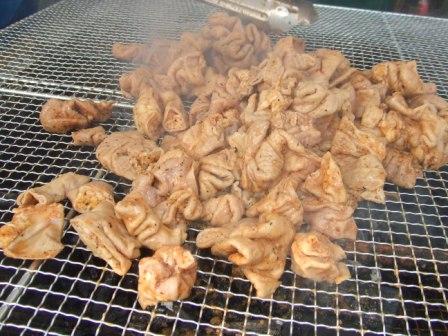
Right now in Japan, “B-kyu gurume” (B-grade gourmet) is very popular among all age groups. B-kyu gurume refers to cheap and delicious comfort food, which are usually served home-style. B-kyu gurume restaurants have always been around, but it is recently that people became interested in them due to the recent economic downturn.
“B-kyu Gurume Festival” was held in Tsuyama, Okayama prefecture this year where 65,000 visitors came to try out these cheap and yummy foods. There were 54 B-grade dishes from all over Japan, which consisted of okonomiyaki, yakisoba, gyoza, and croquette. Among these dishes, Yakisoba (stir-fried noodles) was extremely popular. Because of the large crowd, many people had to wait for 4 hours in order to try out the dishes!
Information on B-kyu gurume can be found all over the Internet as well as on gourmet magazines. There is also even a TV show on cheap and delicious foods known as the "Kitanachelin" which the dishes are rated by famous TV stars.
Friday, July 2, 2010
Learning Japanese

Being in a foreign land where they speak a foreign language, it makes sense to try your hand at learning the local lingo. If you’re an English speaker though, it’s obvious how different Japanese is from English. It’s not like learning German or French where similarities with English abound. Even seasoned polyglots may find that their progress in Japanese may be slower than learning another European tongue. Having said that, learning Japanese is not impossible. In fact, no language is necessarily more difficult than another. All it takes is effort on the part of the learner.
So what’s the best method to be speaking Nihongo like a pro within months? Well, everyone is different so methods will vary, but most agree that immersion is one of the best ways to improve your oral abilities quickly. If you’re in Japan, then perfect. You have no choice but to speak Japanese wherever you go. If you’re not in Japan, try to find a Japanese language circle or course. Failing that, the internet is a great tool for Japanese language studies. Simple search engine searches will bring up useful tools like listening practice sites, grammar guides, dictionaries and even software for making your own flash-cards.
Many language learners and teachers agree that listening and speaking are among the easiest skills to learn in a new language. Especially if you are fully immersed in the target language. Reading and writing skills though often trail behind for most learners. This is often the case with students of Japanese. The writing system is completely alien to those whose languages use the Roman script. Many foreigners living in Japan can speak Japanese very well but struggle to read and write Japanese. This is due mostly to the thousands of Chinese characters or kanji used in Japanese writing. Rote memorization is pretty much the only way to learn kanji. Don’t worry though! Even Japanese people struggle with kanji from time to time.
The topic of language learning is vast and is filled with differing methods. Whatever method you choose, learning a little Japanese will make your visit or stay more enjoyable.
Subscribe to:
Posts (Atom)
Related Posts
